
大丈夫
Chinese commercial space firm completes long-duration test of reusable rocket engine_我的网站

A |
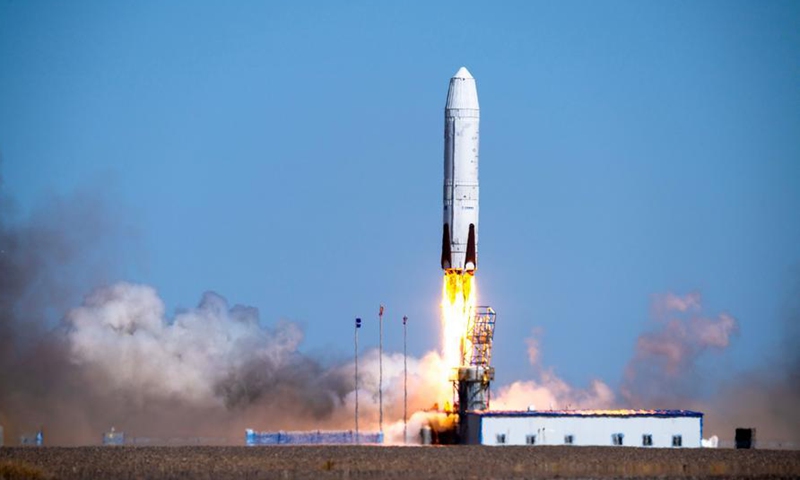
China's commercial reusable launch vehicle sector continues to make steady progress, as a company announced on Friday that it had completed a long-duration test firing of an engine for a large recoverable carrier rocket.
Deep Blue Aerospace, a commercial space startup based in Wuxi, east China's Jiangsu Province, said it recently completed a 100-second static-fire test of its Thunder-RS engine, a 130-tonne-class liquid-oxygen kerosene engine designed for the company's large reusable rocket, Nebula-2.
The test reached 1,297.5 kilonewtons of thrust, or about 132.3 tonnes. The company said multiple short-duration test firings had been conducted previously to evaluate engine performance, with no anomalies recorded.
The recent 100‑second run was the engine's first crossing of that steady‑state duration threshold, serving as a comprehensive verification of its performance, the company said.
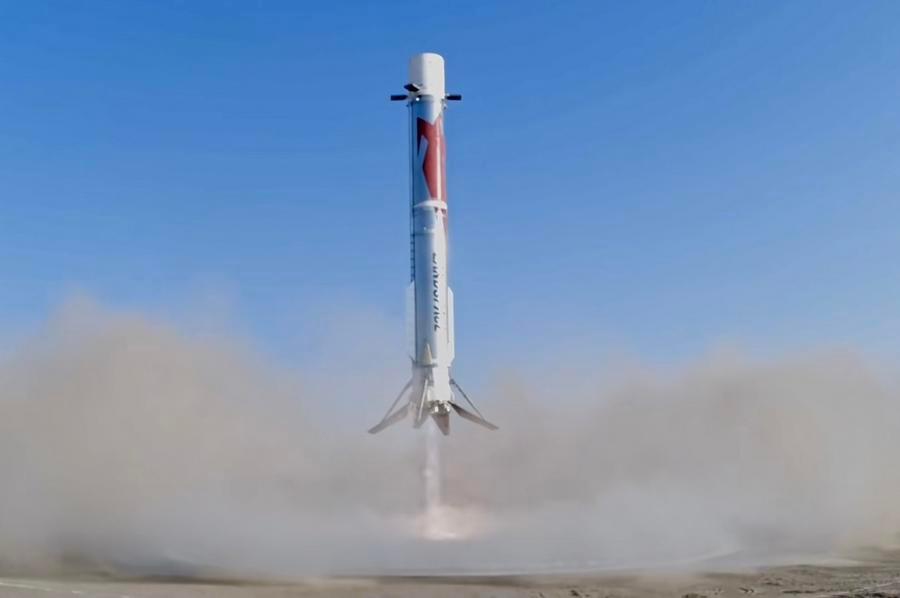
Rocket reusability can greatly cut launch costs and boosts launch frequency, making it key to achieving large-scale, routine access to space.
China launched the reusable rocket Zhuque-3 on Wednesday morning, achieving its first recovery of a rocket's first stage on land, marking the country's first successful land-based recovery. This mission followed the successful sea-based net recovery of the Long March-10B's first stage on July 10.
More models of Chinese reusable rockets are scheduled to conduct tests this year.
。 (ECNS) -- Unitree Robotics has priced its Shanghai initial public offering at 150.80 yuan (about $22.34), the company said on Thursday, with online and offline subscription kicking off next Monday. In a filing to the Shanghai Stock Exchange, the Chinese robotics firm said it was seeking to raise 6.099 billion yuan in gross proceeds, with net proceeds of about 5.917 billion yuan after deducting issuance expenses. The funds will mainly go toward robot R&D, production capacity expansion and embodied intelligence algorithm development. The IPO proposal has secured approval and registration clearance. Unitree plans to float 40.4464 million shares, accounting for 10% of its enlarged total share capital. The offering includes strategic placement, offline book-building allotment and online fixed-price subscription. Unitree estimates its operating revenue for the first half of 2026 will stand between 1.052 billion yuan and 1.128 billion yuan, with net profit attributable to parent company ranging from 258 million yuan to 306 million yuan. Unitree applied under the second set of STAR Market listing criteria which requires an estimated market value of no less than100 billion yuan. Its post-IPO market value will hit approximately 60.993 billion yuan. (By Intern Xu Wenda, Zhang Dongfang)

 。
。Current article:http://www.rangzhuanhoujuedu.cyou/news/20260826_311556.ppt
Published on:10:09:45
我的网站相关内容
 惊天反转!罗德里接近加盟巴萨!皇马可能白忙一场
 PM launches PMJAY-MA Yojana Ayushman cards distribution in Gujarat
 夏天就这么过去了?1月底天气多变,2月初气温将陡降
 大连市中山区关于对未落实防疫要求商家停业整顿的通报
 机器人400米预赛状况百出:有的摔出火星子、有的赛后四分五裂
 张晓龙:维新的比赛和预期还有很大的差距。
- ·China highlights land restoration efforts at COP17 'China Corner'
- ·荒地镇常态化开展护林防火工作
- ·首位身价2亿+的球员,要来了
- ·手机国补领取入口方法和操作步骤!2025国补什么时候结束,手机国补政策将于12月31日正式截止!
- ·制服姿の素朴な女子高生→4年後…… “体重変わってないのに”激変した現在の姿に「努力の結晶すぎるよ」「ほんとに凄すぎる」
- ·Bihar News: खरीदी गई जमीन में भूत-प्रेत का साया... इसलिए बेचने वाले को कुल्हाड़ी से काट डाला; बिहार के जमुई में 'भुतहा' अंधविश्वास
- ·宝马推行全国统一价销售模式,新世代iX3首搭
- ·一个普通清洁工,居然是127外国家公司董事?真相揭开,事情大了
我的网站最新内容
- ·22岁男子篮球赛中突然倒地离世,父亲在直播中目睹
- ·富临精工:终止德阳川发龙蟒17.5万吨合作,35万吨产线调试
- ·学校食堂员工脚踩食材!官方通报:校长免职
- ·可重构光学算术逻辑单元芯片研制成功
- ·"독도는 대한민국 고유 영토" 경북도의회, 독도수호특위 본격 가동
- ·炸锅!17岁张本美和连斩国乒3将登顶WTT,未来3年谁能拦住她?
- ·4,220-year-old rock art in SW China’s Yunnan reveals early cultural links with Southeast Asia
- ·福光股份核心技术人员林文斌增持200股,增持金额5272元
- ·Sara Ali Khan celebrates Sharmila Tagore’s birthday as she shares heartwarming photos
- ·中纪委网通报:李全强被查
- ·名记谈火箭新赛季前景:有望冲击西部第一梯队
- ·数字考古现场!魔改版Tesla M60现身二手市场:双芯16GB显存却不能用
- ·售398.88万起 赛道利器 法拉利296 Speciale/Speciale A国内上市
- ·吉莱斯皮:一直以来我都很相信自己 续约太阳是一个简单的决定
- ·The West’s ‘overcapacity’ narrative is economically illiterate: Josef Gregory Mahoney
- ·博主用AI预测《英雄联盟》S12冠军是RNG或JDG:曾押中高考作文
我的网站热点内容
- ·京东618活动6月17日晚8点开始买最便宜!2025京东618最新红包口令是:红包到手798
- ·China steps up emergency response as Typhoon Dolphin approaches coast
- ·U.S. sanctions 10 individuals for 'transferring cash' to Hezbollah
- ·China defends Manchester consulate violence
- ·長野久義氏が激白!「裸で寝てます」「ノーパン健康法っていうのがあるらしくて」
- ·深圳:以硬核创新铺就强国奋进路,深圳:以硬核创新铺就强国奋进路
- ·China blasts Japanese politicians paying respects to Yasukuni war shrine on 81st anniversary of its unconditional surrender
- ·むっちりの破壊力!初ソロなのにもうギリギリ「大人にしか見えない妖精」同人の女王いくみ「ヤンジャン」登場
- ·Inflation Ticks Up in July, Driven by Spending on Services
- ·上海阿根廷球迷种族歧视被警方带走!被骂的黑人小哥:又不是国足输球
- ·牛逼!76人又来全明星!退役前再联手詹姆斯
- ·利好密集来袭,港股通创新药继续上攻,520880放量连阳!信达生物绩后迅速新高,mRNA肿瘤疫苗赛道热度重燃
- ·जम्मू-कश्मीर के किश्तवाड़ में रिहायशी घरों में लगी भीषण आग, हादसे में आठ लोग घायल; चार की हालत गंभीर
- ·警察又逮到一名9岁小孩开车,还是在这个地区!
- ·北特科技:上半年归母净利润6312.77万元,同比增长14.78%
- ·英菲尼迪纯电动SUV将展出,真正的汽车和内饰将提前在星空图书馆曝光。